The Harmain Journal
How to Use Miswak Correctly: A Step-by-Step Beginner's Guide
August 19, 2026 · Harmain Global
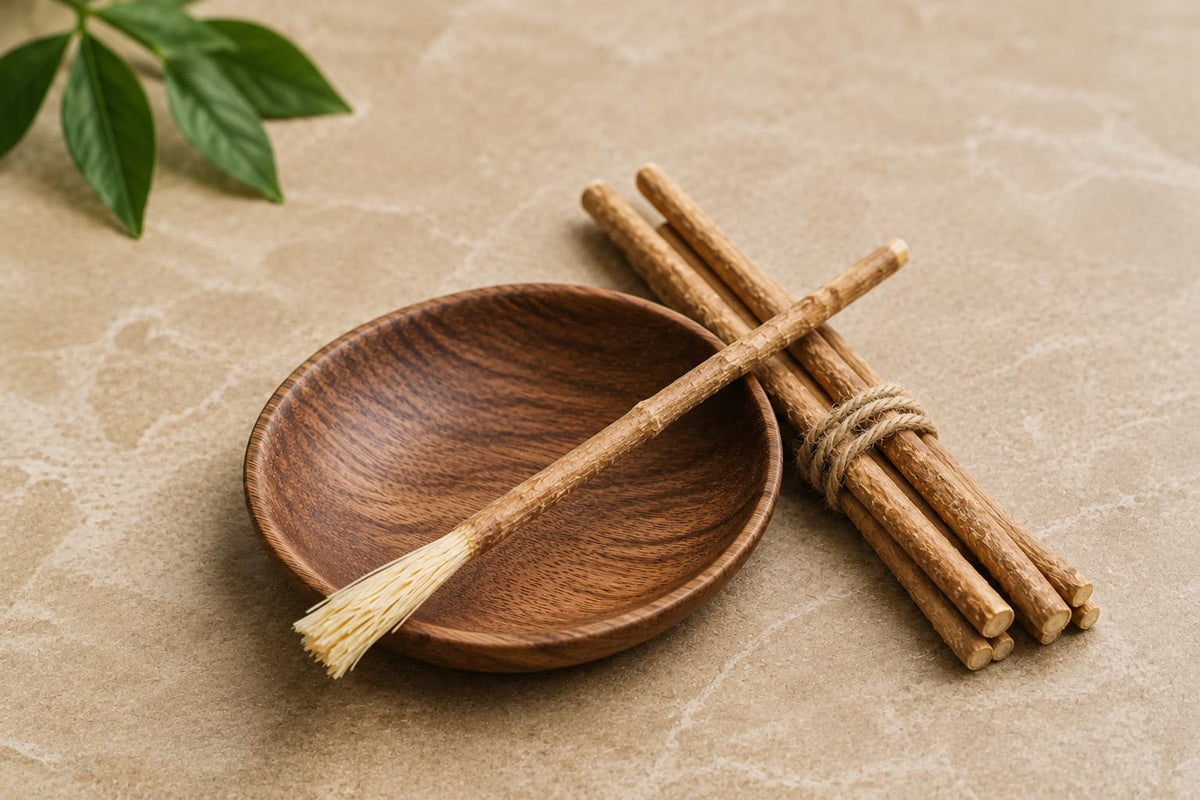
There's a very specific kind of chaos that happens the first time someone hands you a miswak stick with zero instructions. You turn it over in your hand, you chew the end a little like a confused beaver, and you end up with something that looks less like a toothbrush and more like a sad little paintbrush that lost a fight 😅. If this has been your experience so far, relax; you have been doing nothing wrong that the right tutorial can’t solve. There is a real method in the mess that is Miswak, backed by genuine antibacterial research and centuries of daily use across the Middle East, South Asia, and North Africa regions enough times that once you learn the steps it is beyond ludicrously easy. So, let's explore how to use miswak correctly and what you need to do from choosing a fresh stick until the time comes for you to have to exchange it for another one!
Pick a stick that is actually good for the starting place. Traditionally, miswak is derived from the roots of the arak or peelu tree, also known scientifically as the Salvadora persica tree and freshness truly matters more than people realise here. A proper stick will not be dry and brittle, but firm and somewhat flexible, and it should smell vaguely peppery or mustard like (this is actually a good sign—they're the same natural compounds doing the antibacterial work). If a stick gives you an impression of rock hard and snaps rather than bends, it has probably dried out past its useful stage and will therefore not fray regardless of how much you work at it. This is exactly why sourcing matters, since a properly stored, genuinely fresh stick starts you off with a stick that's actually going to cooperate instead of fighting you from step one.
Now for the part that trips up almost every beginner: preparing the tip. From one end of the stick take about half an inch to a full inch and carefully peel down the bark with your fingernail, little knife or teeth if you are bushcrafting without tools. You don’t want to take a big piece, just some of the bark that breaks down into softer fibrous wood below. Once that section is exposed, chew on it gently, rotating the stick slightly as you go, until the fibers begin separating into soft, brush-like bristles. It typically takes anywhere from thirty seconds to a couple of minutes depending on how much the stick has dried. You'll know you're done when the tip genuinely looks and feels like a small, slightly coarse natural brush rather than a chewed up twig. Some people like to soften this process further by soaking the tip in a small cup of water for a few minutes beforehand, which can make the fibers separate a little more easily, especially for a first timer still building the hand feel for this.
Once your brush end is ready, technique is everything, and this is where most beginner frustration actually comes from. Grasp the stick about how you would a pencil, at an angle lightly toward your gums and not flat on the tooth surface similar in spirit to the angled technique dentists teach for a regular toothbrush. Instead of scrubbing back and forth, move along the gumline with short strokes and across the chewing surfaces of your teeth. This part matters more than it sounds like it should. A genuinely interesting randomized controlled trial comparing miswak users against toothbrush users over a two week period found that miswak was just as effective at controlling plaque, but the miswak group actually saw gingival scores rise slightly during the study, and the researchers pointed to overly aggressive technique as the likely culprit rather than any flaw in the stick itself. In other words, the tool works, but heavy handed scrubbing can irritate your gums regardless of what's in your hand doing the scrubbing. Gentle, deliberate strokes are the entire secret here, not force 🪥.
Okay, let's get into the nitty gritty science of what is literally happening at the chemical level because this section is legit interesting and not just folklore dressed up as science. The root of Salvadora persica contains a compound benzyl isothiocyanate, often abbreviated as BITC in the literature and research has found that this substance is considered to be the main antibacterial agent responsible for miswak's antibacterial effects. In vitro studies reported that BITC is a rapid and effective bactericidal agent specifically against gram negative bacteria which includes some of the major pathogens involved in gum disease and periodontal disease. Researchers have also measured how this compound behaves in real use, finding that the highest concentration of BITC shows up in saliva immediately after chewing a fresh section of the stick, and that concentration drops off noticeably after roughly ten minutes of continued use. This isn't a minor detail; it's actually the scientific reason behind one of the most repeated pieces of miswak advice out there, which is to cut a small fresh section of bark off periodically during use rather than chewing on the exact same tip for the entire session. Fresh bark means fresh antibacterial compound release, and that's not superstition; that's chemistry doing its job.
So how often should you actually replace or refresh the tip? A good general rhythm is to trim a small fresh section of bark roughly every few days of regular use, or sooner if the bristled end starts looking worn, discolored, or stops separating into fibers easily when you chew it. A single full length stick, used a couple of times a day with proper tip maintenance, typically lasts somewhere in the range of one to two weeks before it's fully used up, though this varies depending on stick length and how frequently you're refreshing the tip along the way. This is exactly why a lot of regular users end up preferring a miswak for beginners starter option to learn the rhythm first, then move up to a natural miswak stick Pakistan multi pack once the habit sticks, since you'll genuinely go through more than one stick a month with consistent daily use.
This is an honest point, and no one mentions it enough in miswak content, so it deserves a paragraph all to itself rather than being glossed over in passing. Miswak is an actual proven oral hygiene tool backed up by scientific material and the World Health Organization has even called it out and recommended its use as an effective oral hygiene aid. However, that doesn't mean you can just up and replace everything you'd get from a modern toothbrush and toothpaste fluoride routine with it especially with regard to the very specific functions of fluoride's role in enamel remineralization, which miswak does not provide in isolation. The most consistently supported approach across the dental research isn't miswak rather than brushing; it's miswak alongside brushing, using it as a genuinely effective midday or on the go cleaning session between your regular brushing routine, rather than swapping one out entirely for the other. Think of it less as a competition and more as a genuinely useful teammate in your daily miswak brushing technique routine.
Let's round this out with the mistakes almost every beginner makes, so you can skip them entirely. The first is scrubbing too hard, treating the stick like it needs muscle behind it when gentle, repeated strokes do the actual work. The second is using a bone dry, overly aged stick and wondering why it won't fray properly, when the fix is simply starting with a fresher one or giving it a short soak first. The third is chewing the same exact tip for days on end without ever trimming fresh bark, which quietly reduces how much of that active antibacterial compound you're actually getting with each use. The fourth is expecting an overnight transformation, when realistically, like most oral hygiene habits, the benefits of consistent plaque control and fresher breath build over days and weeks of regular use rather than a single session. None of these are complicated fixes; they just take one or two uses to get the hang of, and after that the whole process becomes as automatic as brushing your teeth ever was.
If you're ready to actually build this into your routine, Harmain Global makes it simple to start small and scale up. Grab a single stick to learn the technique, see it here, or if you already know you're in it for the long haul, the 12 piece box is a smart middle ground for a household routine, and the 100 piece bundle exists for anyone stocking up for a mosque, a gift batch, or serious bulk use over several months. Every option is Halal certified and sourced from genuine Peelu root, so you're not left guessing what you're actually chewing on. Curious about bulk options or have a specific question before ordering? Learn more by reaching out directly, or if you're the type who just wants the link saved for later, here it is with nothing extra attached: https://shop.harmainglobal.com.
Once you've got the technique down, this genuinely becomes one of those small daily habits that feels disproportionately satisfying, a few centuries old ritual that turns out to have real chemistry backing it up the whole time. Not bad for a twig 🌱.